Learning platform
 en
en 


The performances of several centre-forwards at the tournament caught the eye of the Technical Study Group (TSG), and the output produced by this playing position in terms of goal involvements increased in Morocco when compared to the previous two FIFA U-17 Women’s World Cups. Below, we explore the ways centre-forwards demonstrated the awareness and ability to receive in behind the opposition’s defensive line, in between midfield and defensive lines, as well as under pressure.

Manufacturing chances through offers
Asako Takakura, one of the TSG experts observing the tournament, reveals that it was the movements several centre-forwards were performing that particularly impressed her. “Almost without exception, teams that progressed deep into a tournament had centre-forwards with a high level of ability. They troubled the opposition by cleverly exploiting space in behind the defensive line or between the lines.”
“In this tournament, teams that played direct and delivered the ball into space behind the defence, rather than spending time building up in midfield, found considerable success in creating goals,” adds Takakura, who won the same competition as Japan’s head coach in 2014. “Centre-forwards who produce this effect are constantly alert to when and how they should offer themselves within the opponent’s defensive shape. In other words, movement away from defenders before receiving the ball is crucial.”
USA’s Lauren Malsom v. China PR
The clip above, featuring Lauren Malsom’s second goal against China PR, demonstrates the types of movements centre-forwards need to perform on a constant basis. When reviewing the lead-up to the number 9’s goal, Takakura notes, “the centre-forward initially makes the run in behind the defensive line, and then, once the opposition’s backline drops deeper, offers to receive the ball between the lines to become the focal point of the attack.”
It is this mindset of finding the new space to set up the pass which is key. Once the pass in behind becomes a genuine option again, “the centre-forward appears to drift briefly out of the flow of play to judge the passer’s timing. It is a movement and combination of very high quality,” adds Takakura.
For Takakura, a centre-forward’s mindset of offering to receive should remain constant. “These two different actions (receiving between lines and behind them) are inseparable and work as two sides of the same coin. Teams with a centre-forward who understands these movements and can draw passes from team-mates will have a higher attacking quality.”
Korea DPR’s Kim Won Sim v. Morocco
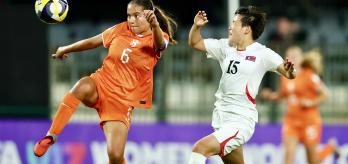
The fluidity of Korea DPR’s centre-forward partnership was one of the tournament’s highlights. Yu Jong-hyang (10) and Kim Won-sim (15) caused headaches for opponents, with the two amassing 15 goals between them and the former winning the adidas Golden Ball and the latter the silver award. The pair’s movement prior to receiving passes contributed to their team’s impressive campaign and set the bar for centre-forward play at the U-17 competition.
The clip above shows Kim in action. In an inverse of the Malsom example, Kim initially offers to run in behind Morocco’s defensive line, before dropping to receive in the space between Morocco’s defensive and midfield units. Crucially, though, the mindset of being opportunistic and finding a new space to receive in as play develops remains the same.
“Both of Korea DPR’s centre-forwards possessed outstanding physical qualities, combining speed, power and technique,” notes Takakura when reflecting on Kim and Yu’s campaigns. “They appeared to have already developed all the attributes required of a top player at this age level. Strong mental toughness and competitiveness were also evident. For 90 minutes, they played at high intensity, receiving the ball in behind the defence and between the lines, then making decisive runs into the penalty area to finish chances.”
Receiving under pressure at FIFA U-17 Women’s World Cup 2025
The previous article in the series explored how direct play in transition was a key theme of the 2025 tournament. Quicker and more direct progression in part feeds into the increased involvement of centre-forwards, who have to play vital roles in receiving the ball, holding up play and bringing others into the game in more contested areas of the pitch.
Despite Korea DPR and other teams progressing deeper into the tournament, such as Italy and Spain, it is important to note that not all participants pursued an approach where centre-forwards were required to retain the ball under pressure. Mexico, Colombia and the Netherlands – who all progressed into the knockout stages – rank below the tournament average for receptions made by centre-forwards in 60 minutes of ball-in-play time. Semi-finalists Mexico are a clear standout, with their centre-forward only receiving 7.7 times under pressure per 60 minutes of ball-in-play time.
Key take-aways
-
Centre-forwards are becoming increasingly involved in goalscoring at the FIFA U-17 Women’s World Cup. This is partly linked with the trend covered in the previous article, direct attacks during transition.
-
Moving to receive the ball in behind or in between lines are two sides of the same coin – a centre-forward needs to have the opportunistic mindset of moving into new space to draw passes out from their opponent.
Rate your experience